Google Cine

Google Cine is a platform concept that reimagines how people discover and choose movies by integrating cinematic content into the Google ecosystem. It focuses on creating a more immersive and personalized browsing experience, allowing users to explore films through dynamically engaged interactions.

CONTEXT:

COURSE PROJECT @POLIMI

TOOLS:

FIGMA, MIRO, MAKEY MAKEY

DURATION:

14 WEEKS

TEAM:

DENIZ KUCUK, FRANCESCA CETRULLO, MADELINE SEE, TEE JIA YU

overview.

Choosing what to watch has become an overwhelming experience due to the abundance of content and lack of clear guidance. Google Cine explores how this process can be simplified by supporting users across pre-, during-, and post-viewing stages.
The goal is to create a more seamless and engaging journey that reduces decision fatigue and enhances the overall viewing experience.

my role.

  • Contributed to research and concept development
  • Conducted user testing and usability evaluations
  • Designed UI for the TV-based experience
  • Developed interactive prototypes using Makey Makey
  • Contributed to research and concept development
  • Conducted user testing and usability evaluations
  • Designed UI for the TV-based experience
  • Developed interactive prototypes using Makey Makey

Most users spend more time choosing what to watch than actually watching it.

research.

PROBLEM STATEMENT

Movie discovery today is fragmented across multiple platforms, requiring users to switch between sources to explore, evaluate, and decide. This scattered experience creates friction in the journey, making it difficult to move seamlessly from browsing to watching.
As a result, users are left without a continuous flow that supports decision-making, leading to a less engaging and less efficient viewing experience.

METHODOLOGY

We conducted surveys, in-depth interviews, usability tests, and evaluations. Methods such as cognitive walkthrough, heuristic evaluation, and open card sorting were used to analyze user behavior and improve the experience.

user personas.

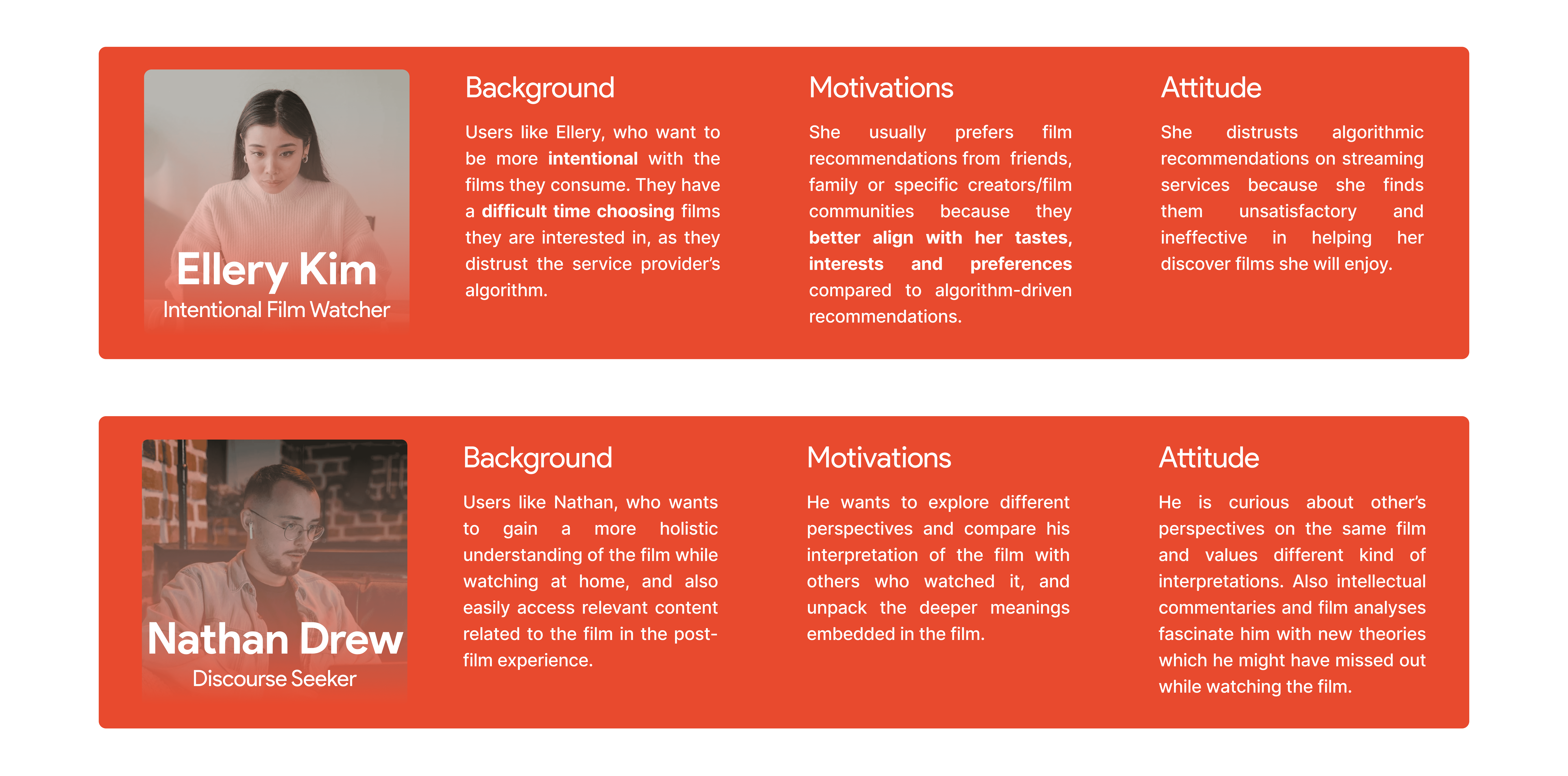
Users approach movie discovery with intention, often influenced by mood, personal taste, and external recommendations. However, their behavior is shaped by time pressure and fragmented platforms, leading them to rely on quick, intuitive decisions rather than a structured exploration.
Showcase image
Showcase image

key insights.

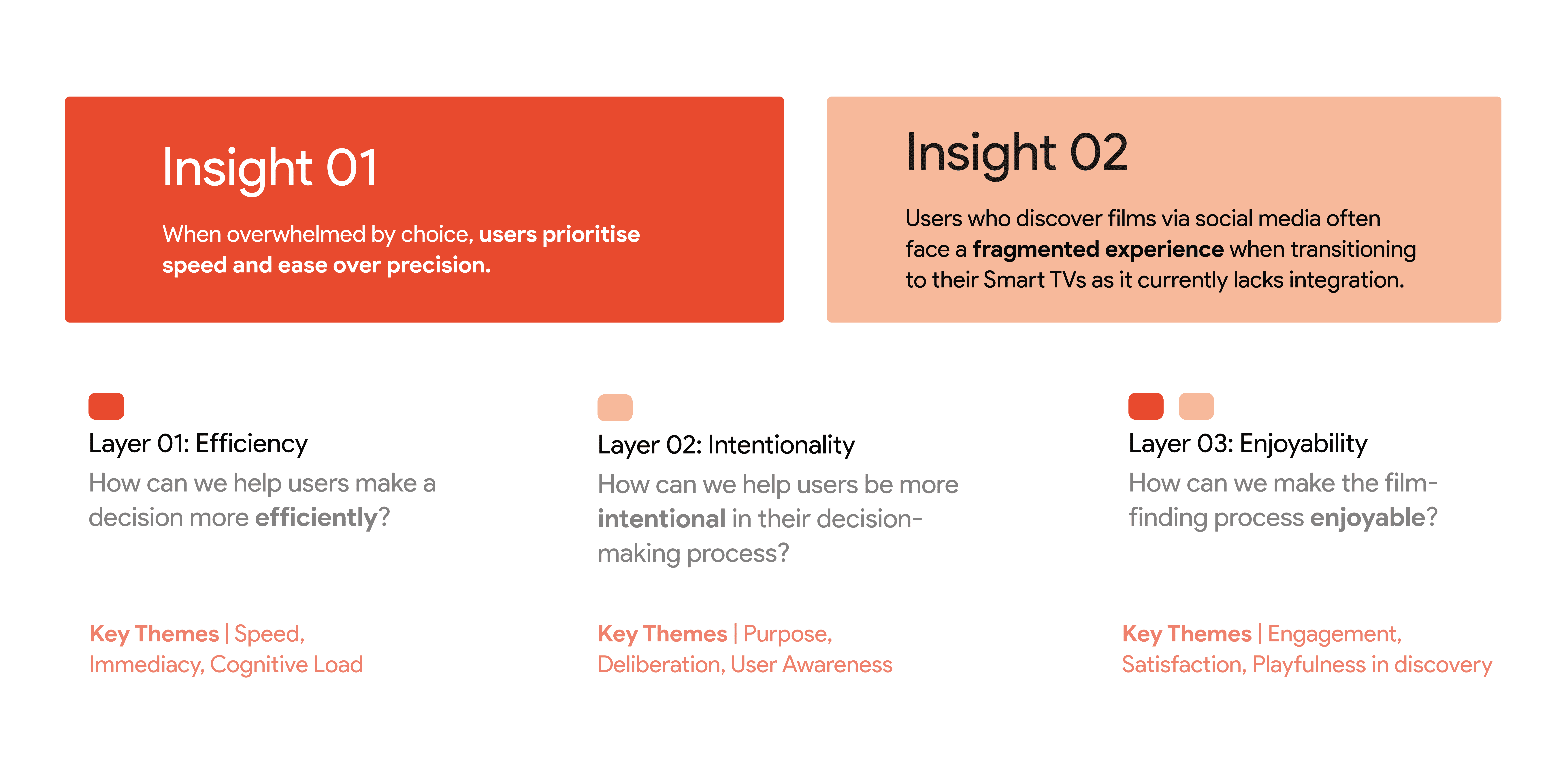
Our research highlighted challenges around overload, fragmented experiences, and surface-level decision-making, leading to a focus on efficiency, intentionality, and enjoyability
remote control.

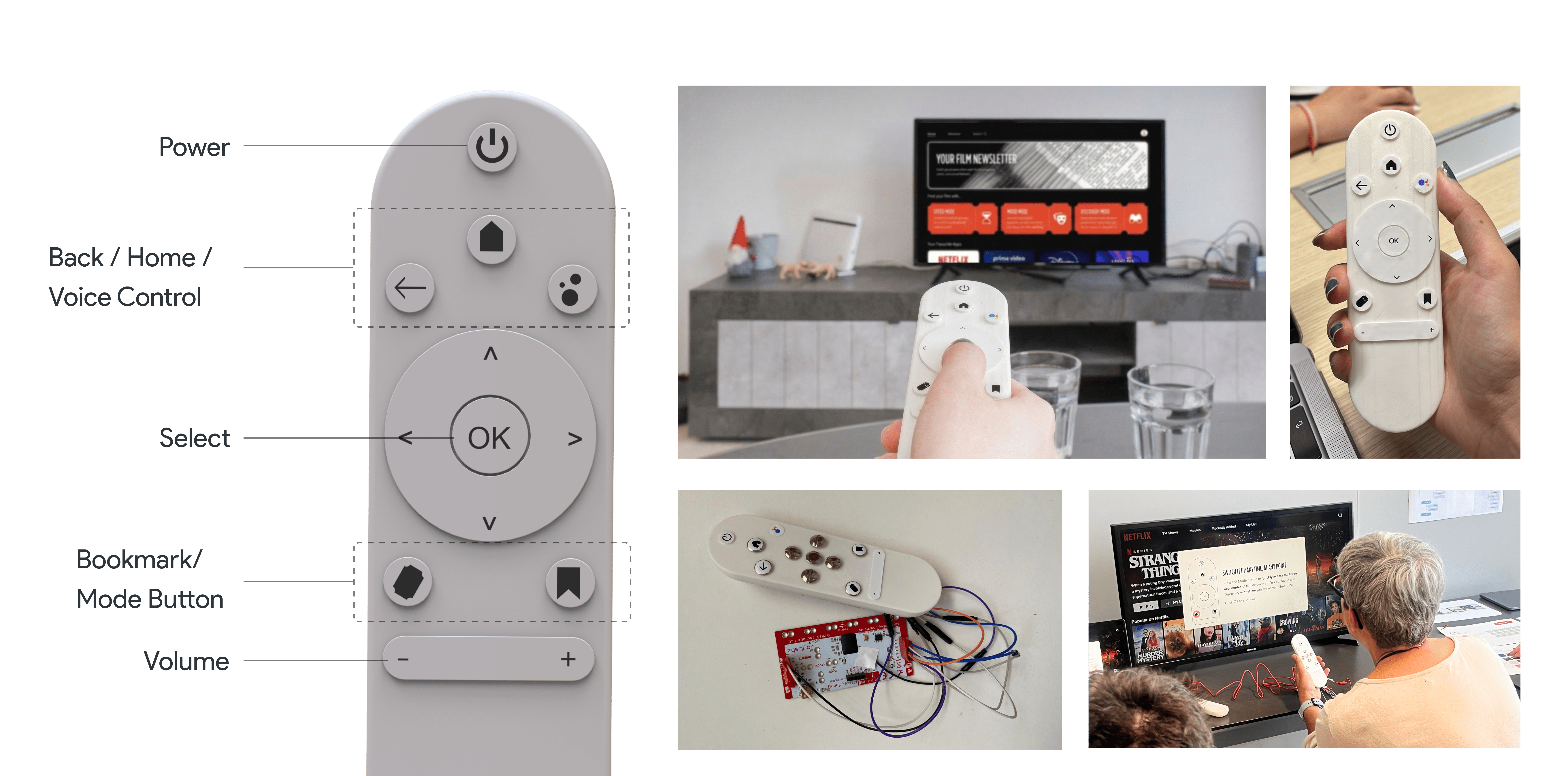
The remote introduces a dedicated mode button for quick access to different discovery paths and a bookmarking feature that allows users to save specific moments during playback. Combined with simplified directional navigation, it supports faster decision-making and more seamless interaction throughout the experience.
It was prototyped using Makey Makey, enabling a functional connection between physical inputs and the on-screen experience.
design system.

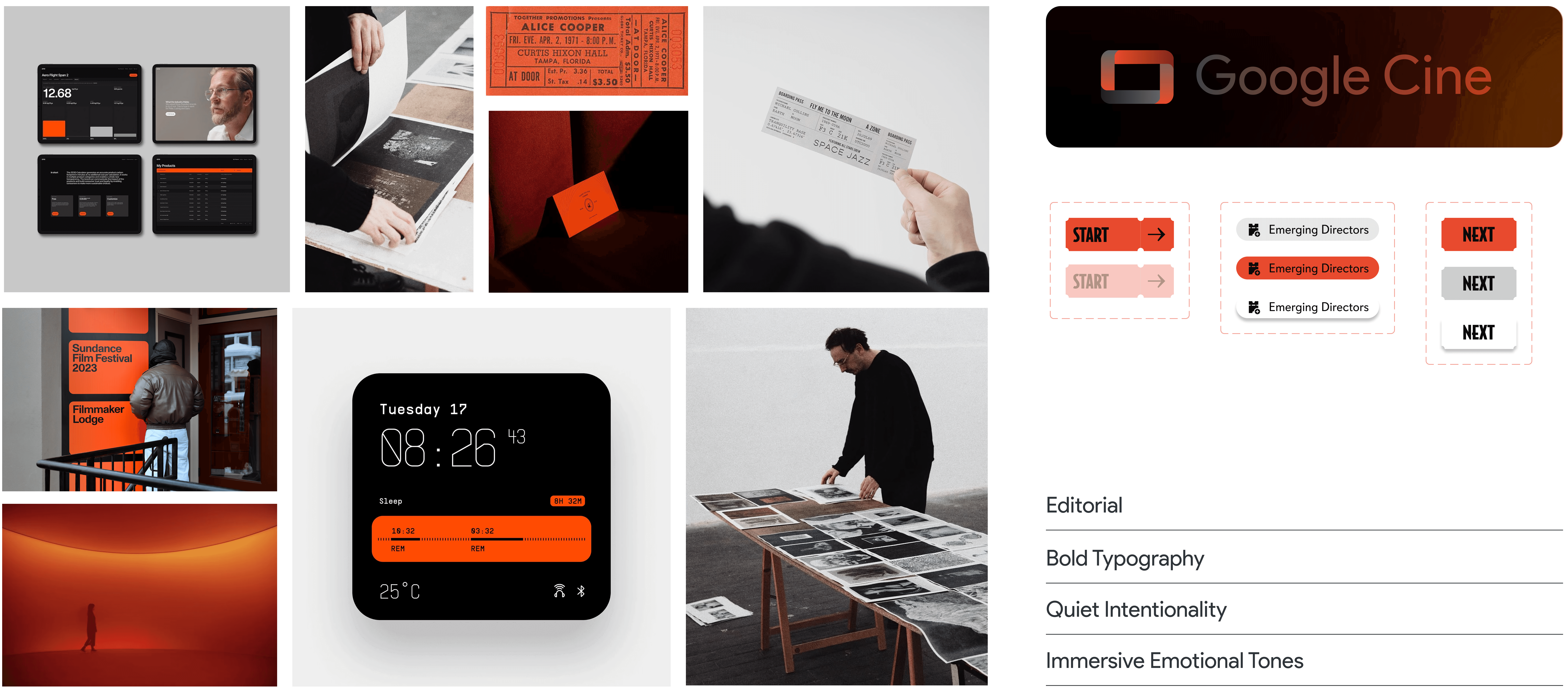
The design system was shaped by a visual direction inspired by cinematic culture, positioning Google Cine as a curated experience for film enthusiasts. It incorporates a defined colour palette, semantic cues, and thematic elements, such as cinema ticket references, to create a cohesive and recognizable identity across the interface.
These design choices support a more immersive and engaging interaction, making film discovery feel more personal and tailored to users’ preferences and moods while maintaining consistency throughout the system.

finalization.

Google Cine brings movie discovery, selection, and post-viewing engagement into a unified experience within the TV environment. Instead of relying on fragmented platforms and passive browsing, it introduces a more guided and responsive system that adapts to users’ intentions, mood, and context.
Google Cine strengthened my approach to designing as a continuous, behavior-driven system rather than a collection of individual features or screens. It highlighted how decision-making, rather than content availability, is the core challenge in movie discovery, and pushed me to focus on clarity, flow, and reducing friction across the entire experience.
Throughout the process, extensive user testing and iterations played a key role in shaping the final outcome. These cycles of testing, feedback, and refinement helped validate design decisions and revealed how small interaction changes can significantly impact the overall experience.
Showcase image
Showcase image
Google Cine strengthened my approach to designing as a continuous, behavior-driven system rather than a collection of individual features or screens. It highlighted how decision-making, rather than content availability, is the core challenge in movie discovery, and pushed me to focus on clarity, flow, and reducing friction across the entire experience.
Throughout the process, extensive user testing and iterations played a key role in shaping the final outcome. These cycles of testing, feedback, and refinement helped validate design decisions and revealed how small interaction changes can significantly impact the overall experience.
Showcase image
Showcase image
Showcase image
Showcase image

journey map.

speed mode.

Supports quick decision-making through structured choices, helping users find a film efficiently while reducing browsing time.

scene bookmarking.

Allows users to save specific moments during a film, enabling easy access to revisit or explore them later without interrupting the viewing experience.

post-film.

Brings together related content and activities in one place, supporting continued engagement and deeper understanding after watching a film.

reflections.

Google Cine strengthened my approach to designing as a continuous, behavior-driven system rather than a collection of individual features or screens. It highlighted how decision-making, rather than content availability, is the core challenge in movie discovery, and pushed me to focus on clarity, flow, and reducing friction across the entire experience.
Throughout the process, extensive user testing and iterations played a key role in shaping the final outcome. These cycles of testing, feedback, and refinement helped validate design decisions and revealed how small interaction changes can significantly impact the overall experience.